

Hiring a ghostwriter involves defining your project goals, vetting candidates for voice and expertise, and signing a “work-for-hire” contract ensuring your ownership. The process generally involves interviewing, creating an outline, drafting chapters, and engaging in multiple feedback rounds. Key steps include setting a budget (often $15,000) + for non-fiction), checking references, and fostering collaboration.
How to Hire a Ghostwriter: A Step-by-Step Guide
- Define Your Project: Clearly identify the project type (e.g., memoir, business book), goal (e.g., thought leadership, legacy), and target audience.
- Determine Budget & Scope: Determine if you need a junior writer or an experienced expert. Non-fiction books often start at $15,000 – $40,000+ , with rates based on experience and project length.
- Find Candidates: Use specialized agencies (e.g., Gotham Ghostwriters), platforms like Upwork or Fiverr, or personal referrals.
- Evaluate Portfolios: Look for adaptability in voice, clear storytelling, and relevant experience. Request redacted samples.
- Conduct Interviews: Check for chemistry, communication style, and understanding of your project.
- Check References: Verify past performance on deadlines and confidentiality.
- Sign a “Work-for-Hire” Contract: Ensure the contract clearly states that all intellectual property (IP) belongs to you, often supported by a Non-Disclosure Agreement (NDA).
How the Ghostwriting Process Works
The collaboration typically involves a structured,, multi-stage approach to transform your ideas into a manuscript:
- Initial Discovery: A consultation to determine the project outline and define the, sometimes evolving, tone and style.
- Interviews & Research: The writer conducts recorded interviews (3–5 days usually) to capture your voice, stories, and expertise.
- Outlining: The writer develops a detailed (15–50 page) outline for approval.
- Drafting: The writer produces chapters in stages, often sending them for feedback on a weekly or bi-weekly basis.
- Revisions & Edits: A two-step revision process is standard: first, for structural/content accuracy, and second, for polishing the voice.
- Finalization: The final manuscript is polished and delivered, at which point final payment is usually made and ownership is finalized.
What to Look for in a Ghostwriter
- Voice and Versatility: Ability to adopt your unique tone, not just theirs.
- Confidentiality: Absolute professionalism in keeping the collaboration secret.
- Strong Organization: Ability to structure complex ideas into a coherent narrative.
- Active Listening: The ability to pull stories out of your head through interview techniques.
Common Red Flags
- Vague contracts that do not mention “work-for-hire” or intellectual property ownership.
- Low-cost providers that offer too-good-to-be-true pricing (may produce low-quality work or plagiarize).
- Inability to provide references or redacted samples.
Disclaimer: The information provided is based on market trends and research as of early 2026.
You have a story to tell. Maybe it is a memoir that spans decades. Maybe it is a business book that could change how people think about your industry. Or maybe it is a thriller novel you have been imagining for years. The problem is simple: writing a full book takes time, skill, and a clear head, and you may not have all three right now.
That is where a ghostwriter comes in.
A ghostwriter is a professional writer who writes on your behalf. The words are theirs. The name on the cover is yours. This is not a secret practice. It is used by CEOs, celebrities, politicians, and first-time authors every single day.
Consider this: a 2021 survey by the Authors Guild found that a large portion of nonfiction bestsellers are produced with writing help. Former U.S. presidents, from Barack Obama to Donald Trump, have worked with writing collaborators on their books. Even thriller legend James Patterson openly uses co-writers and ghostwriters to produce multiple books each year.
The ghostwriting industry is growing fast. More people have valuable ideas and stories. Fewer people have the time to write them well. That gap is exactly where ghostwriters operate.
This guide brings together 19 detailed blog posts on ghostwriting. Together, they cover every question you might have, from cost and contracts to finding the right person and protecting your manuscript. Read each section, then follow the links to go deeper on any topic.
1. How Much Does It Cost to Hire a Professional Ghostwriter
Cost is usually the first question people ask. The answer depends on several factors: the writer’s experience, the length of the book, the genre, and the timeline.
Here is a general breakdown of what you can expect to pay:
| Project Type | Entry-Level Ghostwriter | Mid-Level Ghostwriter | Expert Ghostwriter |
| Short eBook (10,000–20,000 words) | $1,500–$3,000 | $3,000–$7,000 | $7,000–$15,000 |
| Memoir or Nonfiction Book | $10,000–$20,000 | $25,000–$50,000 | $50,000–$150,000+ |
| Business Book | $12,000–$25,000 | $30,000–$60,000 | $60,000–$200,000+ |
| Novel or Thriller | $8,000–$20,000 | $20,000–$50,000 | $50,000–$100,000+ |
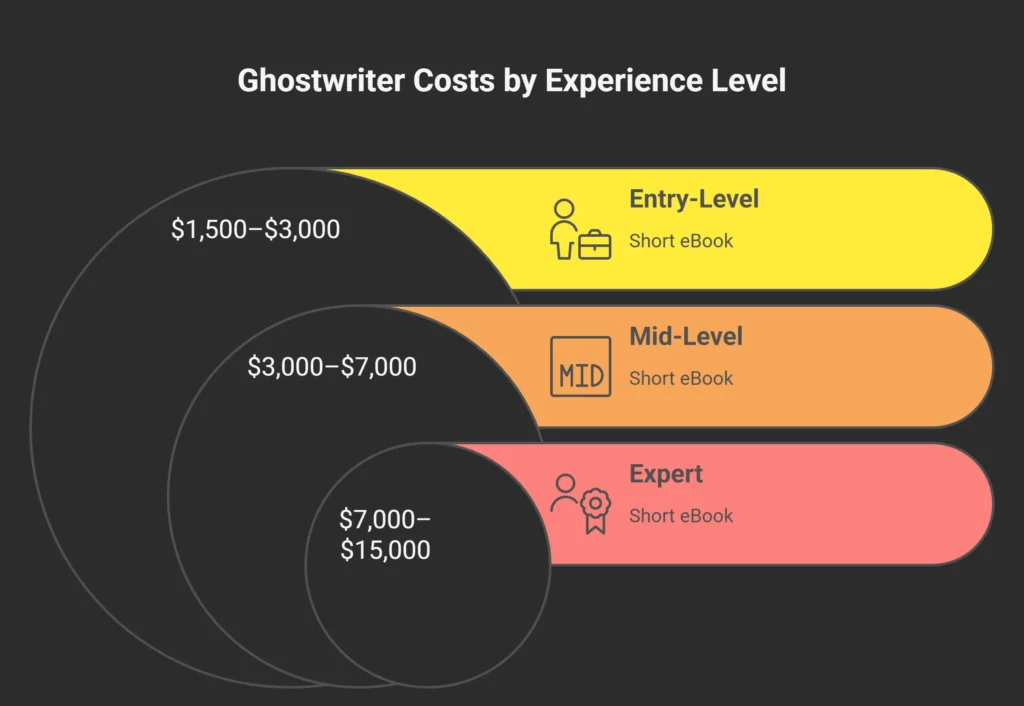
Real-world example: When a tech founder in San Francisco hired a mid-level ghostwriter to write his startup journey memoir, the final price came to $38,000 for a 70,000-word manuscript. That included four rounds of revisions and a final proofread.
Factors that affect pricing:
- Word count and complexity of research needed
- How quickly you need the project finished
- Whether the writer has published clients in your genre
- Whether the package includes editing and formatting
Ghostwriters rarely charge by the word alone. Most use a flat project fee or a milestone-based payment structure. You typically pay a deposit upfront, then split the rest across drafts and final delivery.
Avoid anyone who offers a 60,000-word book for $500. That is almost always a sign of poor quality or stolen content.
Ready to understand what you will really pay? Read the full blog post on ghostwriter costs to see detailed pricing examples and what each tier includes.

2. How to Find a Trustworthy Ghostwriter for Your Book
Finding a ghostwriter is not hard. Finding a trustworthy one takes more work.
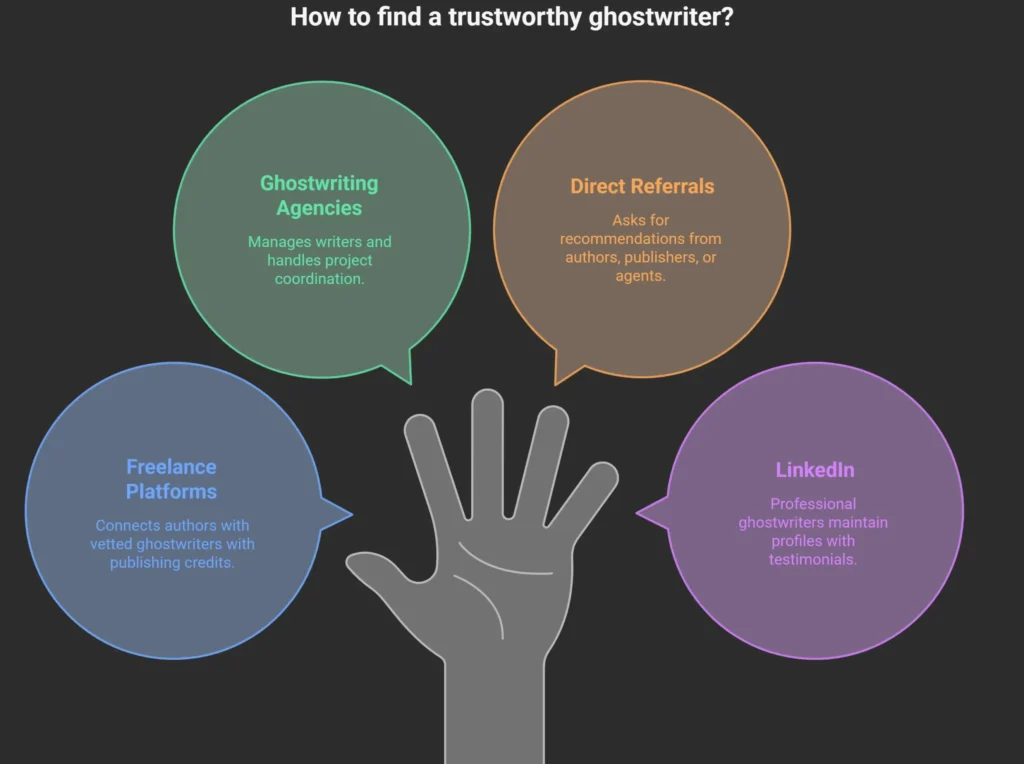
You have several options:
- Freelance platforms: Sites like Reedsy connect authors with vetted ghostwriters who have publishing credits.
- Ghostwriting agencies: These companies manage a roster of writers and handle project coordination.
- Direct referrals: Ask other authors, your publisher, or a literary agent for names they trust.
- LinkedIn: Many professional ghostwriters maintain active profiles with client testimonials.
Real-world example: Canadian memoirist Linda Grayson found her ghostwriter through a Facebook group for indie authors. She asked for referrals, got three names, reviewed their samples, and hired the one who had written in a similar conversational style.
Red flags to watch for:
- No verifiable samples or client references
- Pressure to sign quickly without reviewing a contract
- Vague pricing with no written estimate
- Claims they can write your book in two weeks
Trustworthy ghostwriters are transparent. They ask good questions. They give you a clear process. They have samples you can actually read.
Want to know exactly where to look? Read the full blog post on finding a trustworthy ghostwriter for your book and start your search the right way.
3. What to Look for Before Hiring a Ghostwriter
Hiring a ghostwriter is a big decision. Before you sign anything, there are specific things you should evaluate.
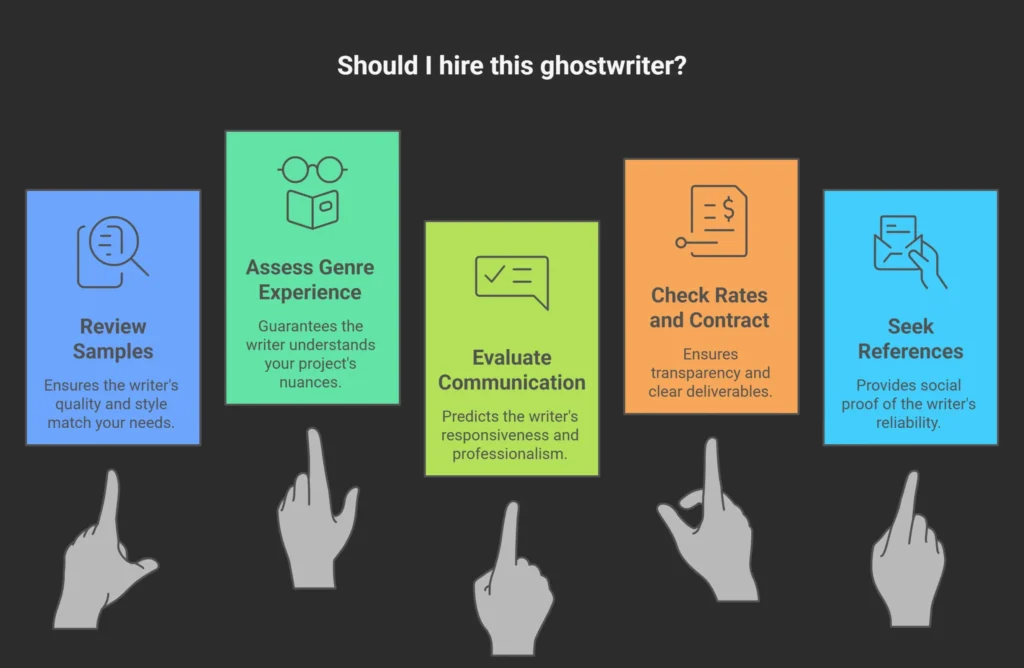
Checklist before you hire:
- Have you read at least two samples of their work?
- Do they write in a style close to yours?
- Have they written in your genre before?
- Do they ask smart questions about your project?
- Are their rates transparent and in writing?
- Do they offer a contract with clear deliverables?
- Can they provide references from past clients?
Real-world example: A business coach in Atlanta hired a ghostwriter based on a polished website alone. The writer had no samples in the business genre and no references. Six months later, the manuscript was unusable. The coach had to start over with a different writer, doubling her costs.
Genre experience matters more than people think. A ghostwriter who excels at romance novels may not have the research skills needed for a medical memoir. A speechwriter may not know how to pace a 300-page thriller.
Also pay attention to communication. Does the writer respond quickly? Are their emails clear and professional? How they communicate before the contract is how they will communicate during the project.
Before you make a move, read the full blog post on what to look for before hiring a ghostwriter. It includes a detailed vetting checklist you can use in your first call.
4. How Does a Ghostwriter Capture Your Voice and Writing Style
This is one of the most common concerns authors have. If someone else is writing your book, how will it sound like you?
Professional ghostwriters use a voice-matching process. It usually includes:
- Voice interviews: Long recorded conversations where you talk naturally about your topic, your life, your opinions
- Writing sample analysis: The ghostwriter studies emails, blog posts, speeches, or old journals you have written
- Style guides: Some writers create a short document that captures your sentence length, word choices, tone, and rhythm
- Draft feedback loops: You review early drafts and flag anything that does not sound right
Real-world example: Bestselling author Alessandra Torre, known for writing under the pen name A.R. Torre, has spoken openly about collaborative writing. Voice consistency is a skill, not an accident. Experienced ghostwriters treat it like learning a new dialect.
The goal is not for the ghostwriter to sound like themselves. The goal is for them to disappear entirely into your voice.
| Voice Element | How Ghostwriters Match It |
| Sentence length | They count your average sentence length and mirror it |
| Humor and tone | They study how you tell stories in conversation |
| Word choice | They note words you use often and words you never use |
| Pacing | They match how fast or slow your natural storytelling moves |
Want to know how this process actually works? Read the full blog post on how a ghostwriter captures your voice and writing style for a step-by-step breakdown.

5. Is Hiring a Ghostwriter Legal and Ethical
Yes. Hiring a ghostwriter is completely legal in almost every country, including the United States and Canada. It has been standard practice in publishing for over a century.
Many people wonder whether it crosses an ethical line. The answer depends on context.
When ghostwriting is clearly acceptable:
- Publishing a memoir, business book, or self-help guide
- Writing speeches, website copy, or marketing materials
- Producing fiction under a pen name
- Any creative work you intend to sell or publish
When it may raise ethical questions:
- Submitting ghostwritten work as your own in academic settings (this is typically against school policies and could be plagiarism)
- Using ghostwritten content to deceive readers about your expertise in a regulated field like medicine or law
Outside of academic fraud, ghostwriting is legally and ethically sound. The author and ghostwriter enter a voluntary agreement. The author provides the ideas, direction, and authority. The writer provides the craft.
Real-world example: Tony Robbins has acknowledged working with collaborators on his books. Robert Harris, the British thriller writer, is one of the few major authors who writes entirely solo, and he has spoken about how rare that is in today’s publishing world.
Is ghostwriting legal in Canada? Yes. Canadian copyright law does not prohibit ghostwriting, and most standard ghostwriting contracts include clauses confirming that copyright transfers to the author upon full payment.
Still have questions about legality? Read the full blog post on whether hiring a ghostwriter is legal and ethical. It covers everything from copyright law to public perception.
6. How Long Does It Take a Ghostwriter to Write a Book
Timelines vary widely. A short business eBook might take six to eight weeks. A full memoir or novel could take six to twelve months, sometimes longer.
Here is a realistic timeline based on book length:
| Book Length | Typical Timeline |
| 20,000 words | 6–10 weeks |
| 40,000 words | 3–5 months |
| 60,000–80,000 words | 5–9 months |
| 80,000–100,000+ words | 8–14 months |
Several things affect how long it takes:
- How quickly you respond to drafts and feedback
- Whether the project needs original research or interviews
- How many revision rounds are included
- The ghostwriter’s current workload
Real-world example: JK Rowling reportedly spent five years on the first Harry Potter book, though she wrote it herself. A ghostwriter working full-time on a similar project could cut that timeline significantly, because writing is their only job.
A rushed manuscript rarely turns out well. If a ghostwriter promises to write your 80,000-word memoir in four weeks, that is a red flag. Quality writing takes time.
Most ghostwriting agencies offer a project calendar at the start of the engagement so you know what to expect at every stage.
Curious about your specific project? Read the full blog post on how long it takes a ghostwriter to write a book and see realistic timelines based on genre and word count.

7. What Is the Step-by-Step Process of Working with a Ghostwriter
Most ghostwriting projects follow a similar structure, even if the details vary by writer or agency.
Typical project phases:
- Discovery call: You and the ghostwriter discuss your project, goals, and timeline
- Proposal and contract: The ghostwriter sends a written proposal with scope, payment, and deadlines
- Voice and content gathering: Interviews, materials review, and style analysis
- Outline: The ghostwriter creates a chapter-by-chapter outline for your approval
- Draft 1: The first full draft, usually delivered chapter by chapter
- Revision rounds: You give feedback, the writer revises
- Final manuscript: A polished, ready-to-publish document
- Handoff: Files are transferred; ghostwriter signs off on copyright (if applicable)
Real-world example: A Canadian attorney hired a ghostwriting agency to write his legal self-help book. The process took eight months. He completed four 90-minute voice interviews, reviewed an outline, then gave feedback on three full drafts before the manuscript was ready.
The key to a smooth process is communication. When authors delay feedback, projects stall. When ghostwriters miss deadlines without notice, trust breaks down.
Want to see the full process mapped out? Read the blog post on the step-by-step process of working with a ghostwriter so you know what to expect from day one.
8. How to Write a Good Brief for Your Ghostwriter
A brief is the document you give your ghostwriter at the start of the project. It tells them what you want, who your readers are, what the book is about, and what tone you are going for.
A weak brief leads to a weak manuscript. A strong brief saves weeks of back-and-forth.
What a good ghostwriting brief includes:
- Book title and working subtitle
- One-paragraph summary of the book’s core message
- Target audience (who is this book for, and what problem does it solve for them?)
- Tone and style (formal, conversational, humorous, serious?)
- Key topics or chapters you want covered
- Books or authors whose style you admire
- What you do NOT want (just as important)
- Deadline and milestone expectations
Real-world example: A ghostwriting agency in Toronto reported that projects with a clear written brief were completed 40% faster than those that started with only a vague phone call. The brief is not just helpful, it is protective. It keeps both sides aligned when disagreements arise.
Cover letter writing follows the same principle. If a writer does not know what you need, they cannot deliver it. A brief removes guesswork.
Ready to write a brief that actually works? Read the full blog post on how to write a good brief for your ghostwriter. It includes a free template and real examples.

9. Ghostwriting vs. Co-Writing: What Is the Actual Difference
Many people use these terms interchangeably. They are not the same thing.
| Feature | Ghostwriting | Co-Writing |
| Credit on the cover | Author only | Both names appear |
| Who gets public recognition | The hiring author | Both parties |
| Typical payment | Flat fee; writer gets no royalties | Revenue share or mixed |
| NDA required | Usually yes | Sometimes |
| Who controls creative direction | Primarily the author | Shared between both |
Real-world example: James Patterson frequently co-writes books. His co-authors are credited on the cover. That is different from ghostwriting, where the hired writer’s name never appears. Both models are valid. The right choice depends on your goals.
If you want full credit and do not want a collaborator named on your book, ghostwriting is the right model. If you are open to sharing credit, and the co-writer brings significant creative value, co-writing may make more sense.
Some authors start with ghostwriting and then move to a co-writing model as they build a long-term relationship with a writer they trust.
Not sure which model fits your project? Read the full blog post on ghostwriting vs. co-writing to understand the real differences and decide which approach is right for you.
10. Who Owns the Copyright When a Ghostwriter Writes Your Book
This is a critical question, and the answer is: whoever the contract says.
In most professional ghostwriting agreements, the author hires the ghostwriter as a “work for hire.” This means the author owns all rights to the manuscript once payment is complete. The ghostwriter has no legal claim to the content.
However, if no contract is signed, copyright law can get complicated. In the United States, the person who creates the work is typically the original copyright holder. Without a clear written agreement, a ghostwriter could technically claim partial ownership.
Three things that must appear in your contract:
- A clear work-for-hire clause
- A statement that all rights transfer to the author upon final payment
- A non-disclosure agreement (NDA) confirming the ghostwriter will not reveal their involvement
Real-world example: A musician hired a freelance writer to produce an autobiography. No contract was signed. When the book became a regional bestseller, the writer claimed co-authorship and demanded royalties. The dispute took two years and significant legal fees to resolve.
Do not skip the contract. Even if you trust the writer, a written agreement protects both of you.
Need a clearer picture of copyright? Read the full blog post on who owns the copyright when a ghostwriter writes your book.
11. How to Sign a Ghostwriting Contract That Protects You
A ghostwriting contract is not just a formality. It is your protection.
Key clauses every ghostwriting contract should include:
- Scope of work: Exact word count, genre, and deliverables
- Payment schedule: Deposit, milestone payments, and final payment terms
- Revision policy: How many rounds are included and what counts as a revision
- Timeline and deadlines: Clear dates for each milestone
- Confidentiality/NDA: The ghostwriter agrees not to reveal their involvement
- Work-for-hire clause: All rights transfer to you upon final payment
- Kill clause: What happens if the project is cancelled by either side
- Dispute resolution: How disagreements will be handled
Real-world example: Alice Sullivan, a novelist who has written about her publishing experiences online, has noted that the biggest mistake first-time authors make is treating a contract like a handshake. Once money changes hands and writing begins, a verbal agreement means nothing.
Do not rely on a ghostwriter’s standard contract alone. Have an attorney or a contracts-literate publishing professional review it before you sign. Many ghostwriting agencies now offer lawyer-reviewed contracts as part of their packages.
Want to know what to look for line by line? Read the full blog post on how to sign a ghostwriting contract that protects you.
12. How to Work with a Ghostwriter Remotely and Still Get Great Results
Most ghostwriting projects today happen entirely online. That does not mean they need to be impersonal or difficult.
Tools that make remote ghostwriting work:
| Tool Type | Purpose | Examples |
| Communication | Regular check-ins and quick questions | Zoom, Slack, email |
| File sharing | Draft exchange and comments | Google Docs, Dropbox |
| Project tracking | Milestone visibility | Trello, Notion, Asana |
| Recording | Voice interviews | Zoom recordings, Otter.ai |
The key to a successful remote project is structure. Set a weekly or biweekly check-in call. Agree on a response time for emails. Decide how drafts will be shared and commented on before the work begins.
Real-world example: A memoir writer in British Columbia worked with a ghostwriter based in New York. They met every Tuesday on Zoom for 30 minutes and shared drafts via Google Docs. The manuscript was finished in seven months with no major communication issues. Their secret? They agreed on a communication protocol in week one and stuck to it.
Many ghostwriting agencies now handle all project management for you, which removes most of the coordination burden.
Want to run a smooth remote project? Read the full blog post on how to work with a ghostwriter remotely and still get great results.

13. Why So Many Successful Authors Use Ghostwriters
The stigma around ghostwriting is fading fast. More authors are open about using writing help, and for good reason.
Common reasons authors use ghostwriters:
- They have the ideas but not the time to write
- They are experts in their field but not experienced writers
- They want to publish multiple books per year
- They write in a second language and need help with fluency
- They are recovering from illness, injury, or burnout
Famous musicians have used ghostwriters for decades. Successful self-help authors often publish two or three books a year, which would be impossible without writing assistance. Many thriller writers work with teams of researchers and ghostwriters to maintain a high publishing pace.
Real-world example: Robert Harris, the British political thriller writer, has spoken in interviews about how rare it is for modern authors to produce bestsellers entirely alone. The publishing industry has always been a collaborative space, even when that collaboration stays behind the scenes.
Using a ghostwriter does not mean you had nothing to say. It means you found a skilled person to help you say it better.
Curious about the real reasons behind the trend? Read the full blog post on why so many successful authors use ghostwriters and see the data behind the shift.
14. What Genres and Book Types Do Ghostwriters Write
Ghostwriters work across nearly every genre and format. Some specialize. Others are flexible.
Common genres ghostwriters cover:
- Memoir and autobiography: Personal stories, family histories, athlete memoirs
- Business and self-help: Leadership books, productivity guides, career advice
- Fiction: Thrillers, romance, science fiction, fantasy, literary fiction
- Children’s books: Picture books, middle grade, young adult
- True crime: Investigative stories, courtroom dramas
- Screenplays and scripts: Feature films, TV pilots, podcast scripts
- Academic and professional: Textbooks, white papers, policy documents
Real-world example: A retired detective hired a ghostwriter to turn her case files into a true crime memoir. The ghostwriter specialized in narrative nonfiction and had previously written two similar books. The project took nine months and the book was picked up by a small Canadian press.
Not every ghostwriter can write every genre well. A writer who excels at memoir may struggle with the pacing required for a thriller. Always confirm genre experience before hiring.
Want to know if your book type is a good fit? Read the full blog post on what genres and book types ghostwriters write for a breakdown by category.
15. How to Know If a Ghostwriting Agency Is Legit or a Scam
The ghostwriting industry has legitimate agencies and predatory ones. Knowing the difference can save you thousands of dollars.
Signs a ghostwriting agency is legit:
- They have verifiable client reviews and testimonials
- They share sample work upon request
- They offer a written contract before taking payment
- They have a physical address and real contact information
- Their pricing is transparent, even if ranges rather than exact figures
- They do not promise unrealistic results like guaranteed bestsellers
Red flags that suggest a scam:
- High-pressure sales tactics or urgency (“this price expires in 24 hours”)
- No portfolio or only vague references to past work
- Requests for full payment upfront before any work begins
- Promises that are too specific, like “your book will be on Amazon’s bestseller list”
- No contract, or a contract with no refund or dispute clause
Real-world example: A Canadian author paid $12,000 upfront to an agency with no verifiable reviews. After two months of delays and excuses, the agency became unreachable. She filed a dispute with her credit card company but recovered only a portion of the money.
Protecting yourself starts with doing your research. Read the full blog post on how to know if a ghostwriting agency is legit or a scam before you write any checks.

16. What Questions Should You Ask a Ghostwriter Before Hiring
Your first conversation with a ghostwriter is a job interview. You are the employer. Ask the right questions.
15 questions to ask a ghostwriter before hiring:
- What genres have you written in?
- Can I see two or three writing samples?
- Have you ghostwritten a full book before?
- How do you match a client’s voice?
- What does your typical project process look like?
- How do you handle revisions?
- What is your current workload?
- How often will we communicate?
- What happens if you miss a deadline?
- Do you use a contract?
- Do you include a confidentiality clause?
- Who owns the copyright after the project is done?
- How do you handle sensitive or personal content?
- What is your payment structure?
- Can you provide a reference from a past client?
Real-world example: A Toronto-based author asked all 15 questions to three different ghostwriters she was considering. One writer became defensive about the copyright question. She crossed that person off her list immediately. The writer she hired answered every question clearly and sent a sample contract within 24 hours.
Questions reveal character. A confident, professional ghostwriter will welcome them.
Get the full list with follow-up questions included. Read the blog post on what questions to ask a ghostwriter before hiring.
17. How to Review Ghostwriter Samples Before Making a Decision
Samples are the most important part of the vetting process. But knowing how to read them makes all the difference.
What to look for when reviewing ghostwriter samples:
- Voice variety: Can the writer adjust tone for different clients?
- Pacing: Does the writing move at a comfortable speed?
- Clarity: Are the ideas easy to follow?
- Structure: Is the opening strong? Does each section have a clear point?
- Authenticity: Does it feel natural or forced?
What to ask when you receive samples:
- Is this sample representative of your work, or was it heavily edited by someone else?
- How long did this project take?
- Did the client give you detailed direction, or did you have creative freedom?
Real-world example: A self-help author reviewing ghostwriter samples noticed that one writer used the same three sentence structures throughout every sample. The writing was technically clean but felt mechanical. She hired a different writer whose samples varied in rhythm and felt more alive on the page.
Samples can also reveal research skill. Look for accuracy, specificity, and whether the writer uses concrete examples or only vague generalities.
Want a complete framework for reviewing samples? Read the full blog post on how to review ghostwriter samples before making a decision.

18. What Happens to Your Manuscript After the Ghostwriter Finishes
Many authors do not think past the final draft. But the work does not end when the ghostwriter delivers the manuscript.
What typically comes next:
| Stage | What It Involves |
| Developmental editing | Structural feedback on flow, pacing, and argument |
| Line editing | Sentence-level clarity and style improvements |
| Copy editing | Grammar, punctuation, and consistency |
| Proofreading | Final read for typos and formatting errors |
| Formatting | Layout for print or digital publishing |
| Cover design | Visual identity for the book |
| Publishing | Self-publishing or submission to agents/publishers |
Some ghostwriting packages include editing as part of the fee. Others deliver only the raw manuscript and leave editing to the author.
Real-world example: A fiction writer in Vancouver received a polished 75,000-word manuscript from her ghostwriter. She assumed it was ready to publish. Her developmental editor flagged 14 structural issues in the first read. The editing process added three more months to the project but produced a much stronger book.
Plan for post-manuscript costs before you start the project. Editing, design, and publishing all add to your total investment.
Want to know what comes after the manuscript? Read the full blog post on what happens to your manuscript after the ghostwriter finishes.
19. Best Ghostwriting Services in Canada for Authors in 2026
Canada has a growing network of ghostwriters and ghostwriting agencies serving authors across the country. Whether you are in Toronto, Vancouver, Calgary, or a smaller city, there are qualified professionals available.
What makes a ghostwriting service stand out in Canada:
- Experience with Canadian publishing standards and style guides
- Familiarity with Canadian English spelling and idioms
- Understanding of Canadian legal frameworks for copyright and contracts
- Knowledge of Canadian publishing markets and distribution channels
What to look for in 2026 specifically:
- Agencies that offer AI-assisted research tools with human writers doing the actual writing
- Services that include publishing consultation alongside writing
- Writers who specialize in Canadian voices, histories, and cultural nuance
- Transparent contracts aligned with current Canadian copyright law
Real-world example: An Edmonton-based entrepreneur hired a Canadian ghostwriting agency in 2025 to write his business memoir. He specifically wanted a writer who understood the Western Canadian oil industry and could write with regional authenticity. The agency matched him with a writer from Calgary who had covered the energy sector as a journalist for a decade. The result was a manuscript that felt grounded and real.
When evaluating Canadian services, ask whether the writers are Canadian or based internationally. Many agencies use global writer pools, which is not inherently bad, but matters if regional knowledge is important to your project.
Looking for the right Canadian service? Read the full blog post on the best ghostwriting services in Canada for authors in 2026 for a curated breakdown.
Conclusion
Hiring a ghostwriter is not a shortcut. It is a professional decision, and like any professional decision, it works best when you go in prepared.
This guide has covered all 19 essential topics you need to understand before you begin. From pricing and contracts to voice matching and manuscript handoffs, every part of the ghostwriting process has been addressed.
The most important things to remember:
- Know your budget before you start looking
- Vet every writer through samples and references
- Sign a contract that includes a work-for-hire clause and an NDA
- Communicate clearly throughout the project
- Plan for editing and publishing costs after the manuscript is done
Ghostwriting has helped thousands of authors, executives, musicians, and professionals turn their ideas into published books. It has been used by some of the most successful authors and public figures in the world. Used correctly, it can help you do the same.
Start with the sections most relevant to your situation. Follow the links to the full blog posts for deeper guidance. And when you are ready to take the next step, do it with confidence because now you know exactly what to look for.